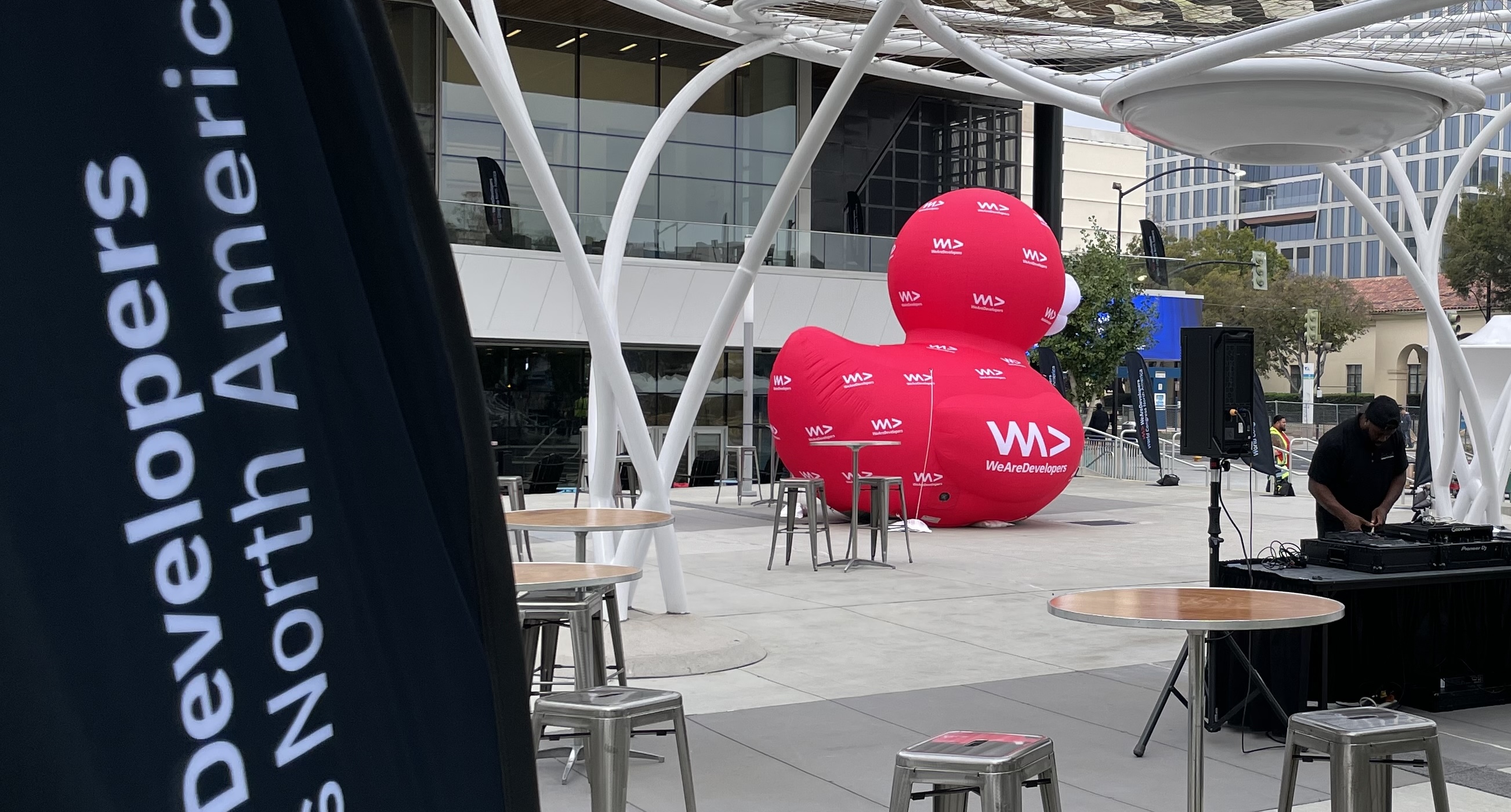
This past week, I attended WeAreDevelopers World Congress in San Jose, California. This was the first time this conference has been held in North America and they started with a huge offering, stating 10,000 attendees! I am fortunate enough to get a budget from my work for learning and professional development, and I was looking for a way to learn about the most up-to-date strategies for being an effective software engineer in the industry today. I’m happy to say that this conference achieved that, along with providing the opportunity to meet many great new people.
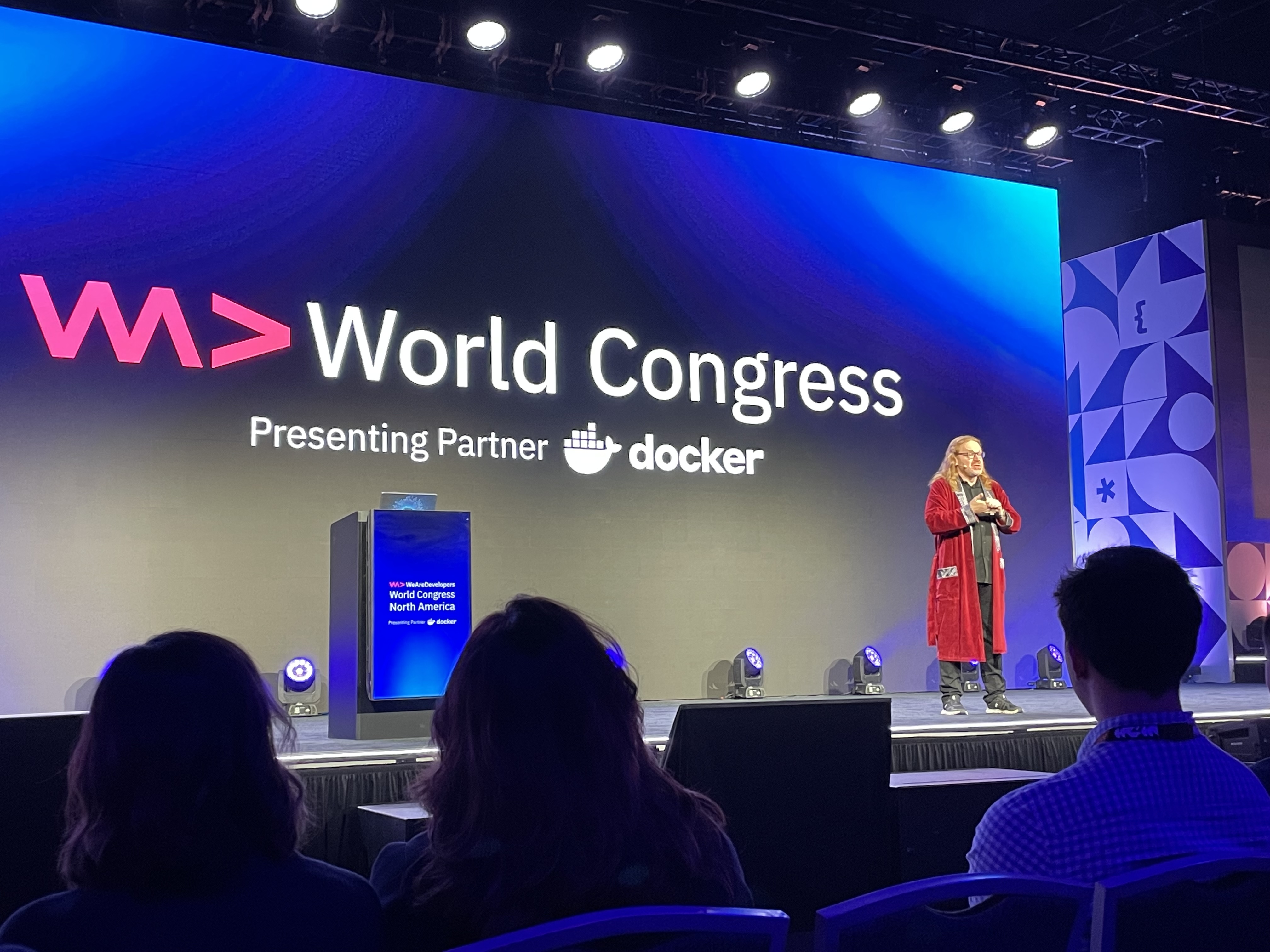
Chris Heilmann from WeAreDevelopers opening the conference.
Like any software conference these days, so much of the content was focused on AI. On one hand, it’s having such a large impact on everything that you cannot escape it. It must be acknowledged and discussed. On the few occasions where I attended a talk that didn’t mention AI, it was refreshing, but also felt lacking. To not talk about AI in a dev conference session is like not talking about EVs at a car show. The interesting thing I found was that about half of the sessions talked about safety and health, either how to run AIs more securely, or how to interact with them in a more healthy way. The other half of the sessions were about how to use AI even more.
I saw a few talks that mentioned the phases of AI development, and where we are along the path.
| Intelligent autocomplete | Coding LLMs | Agent teams | Automatic coding | “Dark Factories” |
|---|
The phases of AI development.
A few years ago, we all were amazed with Copilot because of the code auto-complete. Start typing, then tab to auto-complete the function. Now, that seems so far away. Most of us are well beyond that and now regularly use coding agents which can write the whole code for us with just a few paragraphs of text. It’s no longer auto complete, it’s just “complete”. The next phase, where some are in, but most are not, is in teams of agents and loops. I’ve only started to dabble with this, but the concept is that you have agents play different roles. One for coding, one for reviewing, one for testing. And it’s only after they all accept the result (or if your “product manager” agent accepts it), is the code complete.
Fewer organizations, as far as I can tell, are going beyond that. Automatic coding refers to agents that will automatically pick up issues as they are reported or discovered internally, and the fix is implemented. A human then does the review before release. The final boss is “dark factories”. The term comes from the idea in manufacturing where all of the work can be done robotically, so you don’t even need to keep the lights on. You just trust the automation to work correctly all the time. In software, a dark factory means all the implementation, validation, verification, and delivery is done by agents. No humans in the loop anymore. The obvious question is “how can you get to the level of trust to be able to implement this?” I heard a lot of obvious answers to that: “add testing”.
A lot of folks are dealing with the ramifications of the fact that engineering code is no longer the bottleneck. It’s becoming the easiest part of software development. Someone said “we will quickly no longer write code, but we will write documentation for the agents to code”. The rest of the effort goes in to compliance and acceptance testing and into building risk tolerance and rollback capabilities.
On the safety side, the big standout was Docker Sandboxes (aka SBX), which is a way to run coding agents inside of secure, isolated MicroVMs. This promises to empower us to run agents to do their work and be super effective. It also lets us trust that those agents will not be able to access the rest of the computer, because of the file system sandboxing, or collude by resurrecting a long-dormant German wiki site, because of network access restrictions. I’m very curious about SBX and would love to see if I can run sandboxed agents by default whenever I invoke a coding agent. If I can get the safety and control without too much added friction, it might be nice.
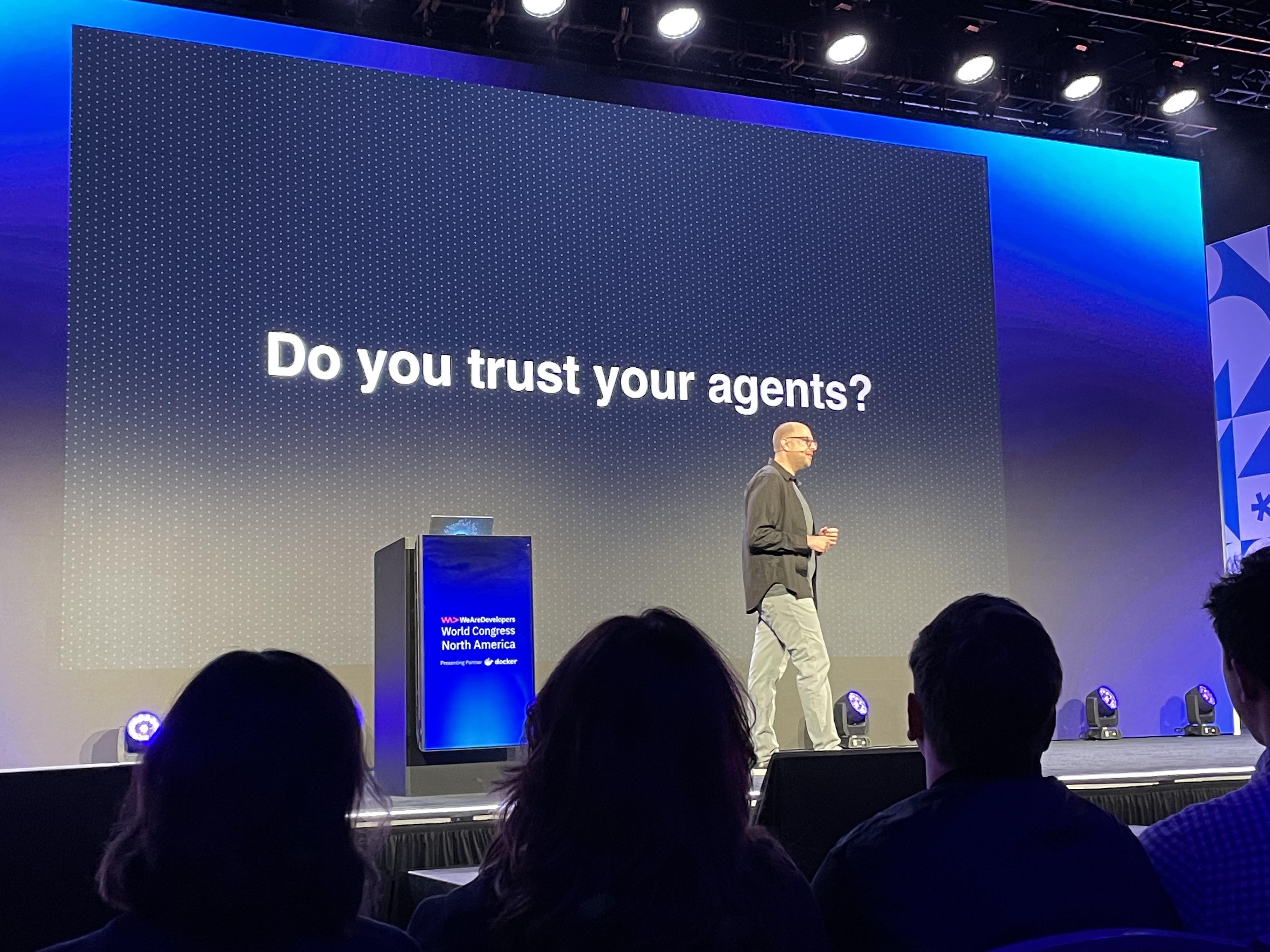
Mark Cavage from Docker giving a keynote talk about sandboxes.
During the workshops explaining sandboxes, I built a sandbox “kit” (an extension of sorts) to run my coding agent with Grafana’s new agento11y CLI to capture the conversations, tool calls, and processing the agent does and save it to my Grafana Cloud account. You can try it for yourself! Massive shoutout to Oleg Šelajev and Michael Irwin, both from Docker, for giving great workshops that inspired me to get hands on with the project.
The other half of safety is the human side. How can we protect ourselves from feeling burned out, from feeling aimless, like we’ve lost something about what made us software engineers? Someone said “it’s easy to feel like we’re losing what made us special when now anyone can generate code.” It’s not the code that makes software engineers special; it’s our reasoning ability, our systematic knowledge, and our approach to problem solving that does. Unfortunately, it’s still hard to grasp all that when someone says “what do you do?”
Cassidy Williams gave an excellent mainstage talk about keeping our brains healthy as we shift more and more of the work to AI. One of the biggest things is to regularly put into place activities that encourage us to learn. I’ve found that AI can be super helpful for learning, but it can also be super helpful for simply replacing effort. For example, I’ve used LLM agents a ton to learn about new CNCF technologies, why someone would learn one over the other. That was so useful when preparing for the certification exams. I’ve also used LLMs to simply “create an X that does Y”. Nothing gets learned there. The latter is not “wrong”, but it doesn’t engage our brain like the first one does.
Finally, the health aspect also touches on the importance of community. Gwyneth Peña-Siguenza gave a talk about how agent skills helped scale the repositories she was working on, but what stuck out to me was at the end where she emphasized giving to the community.
When you have the ability to help, you have the responsibility to do so.
I was also inspired by a talk by Steve Chen, executive director & founder of Code & Coffee, who talked about the importance of gathering in-person. I’ve always loved the community aspect of open source software and of conferences, and I especially love how happy people are when we talk about Grafana. I’ve kicked around the idea of trying to initiate a developers meetup here in Rochester. Maybe someday…
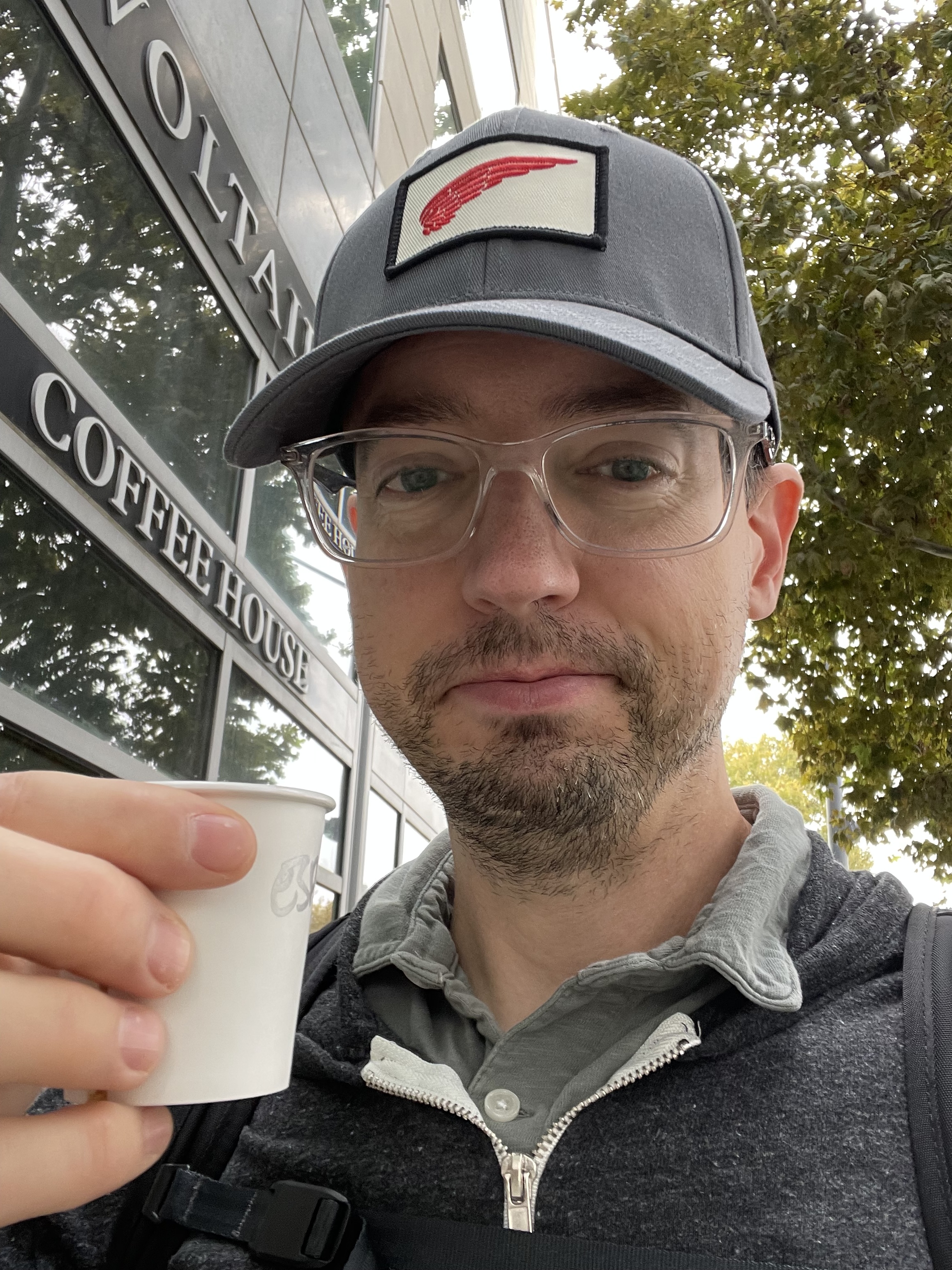
Conference fuel.
I’d be remiss if I didn’t mention being in the Bay Area again. It’s been roughly seven years since I had been there and it was great to be back. The weather is perfect, the tech community is unparalleled, and the energy for learning is strong. My wife jokes that whenever I go, I’m visiting the “mother ship”. I mean… she’s not wrong. I can’t deny the excitement I get when I go there, and feel a bit like I’m missing out by being in Minnesota. There’s just so much innovation and enthusiasm that it feels infectious.
San Jose itself was a lovely city, and I wish I was able to have seen more of it. It’s also just nice to be in a city that’s very walkable when the weather’s nice. Every morning, I would stop by Voltaire Coffee Roasters and grab an espresso on my walk to the venue. On the last day, I went to San Pedro Square Market and got an amazing pizza, which was a killer recommendation from the security guard there!
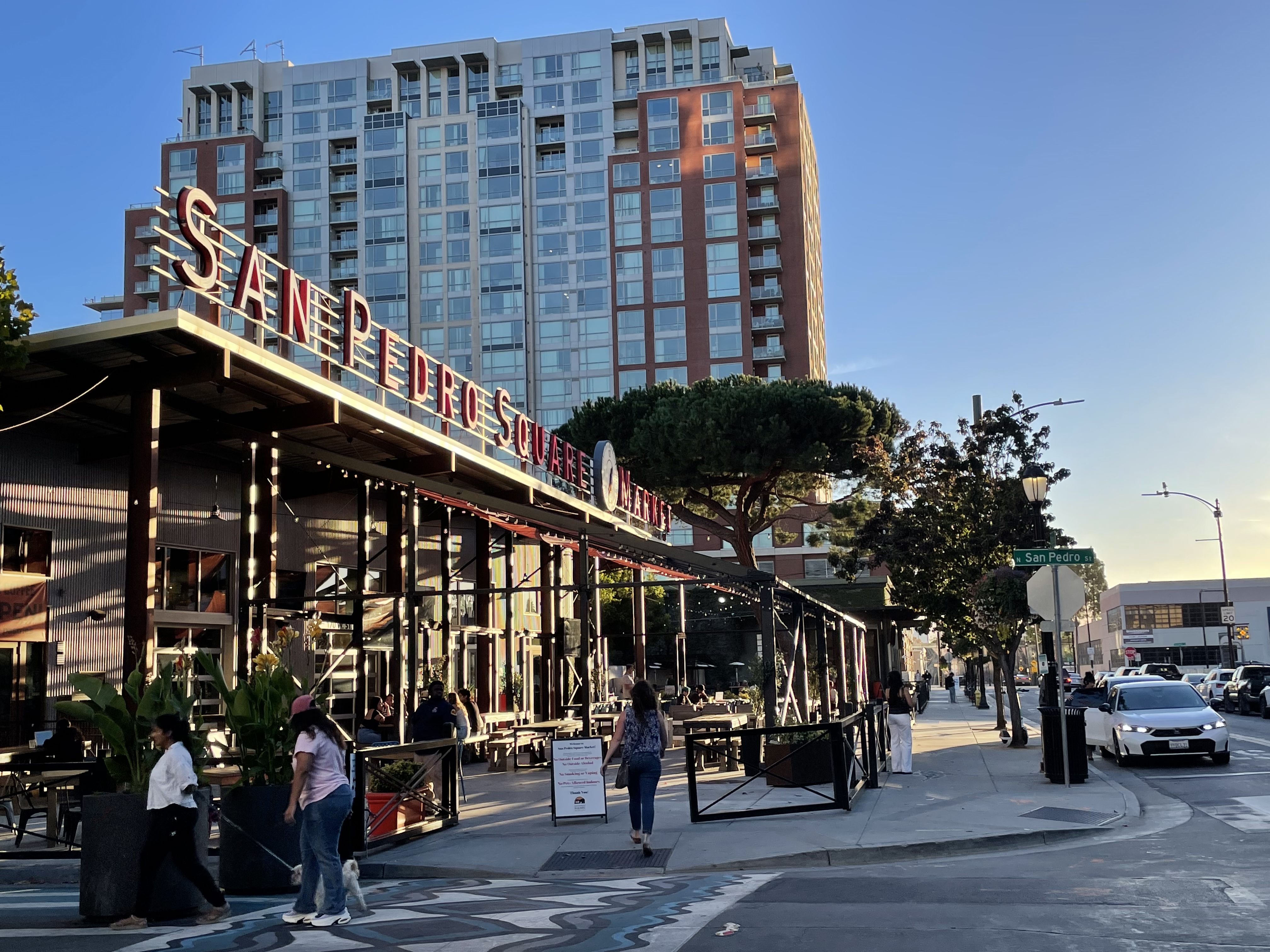
San Pedro Square Market.
I’m seriously considering returning to this conference next year. I hope it continues to grow and attract more excellent content.