
A few years ago, I wrote Summoning Ghosts about standing up this blog on Ghost, running in my home lab Kubernetes cluster. At the time, it was a great excuse to exercise the cluster: a real workload with a database, dynamic DNS, automatic TLS, and an Ingress object I could point at. It worked. For years.
But over those years, the parts of the deployment I cared least about were the parts that needed the most attention: Ghost upgrades, database backups. And while the Ghost content management was nice, it made it harder to author posts and keep things going here.
So I busted the ghosts.
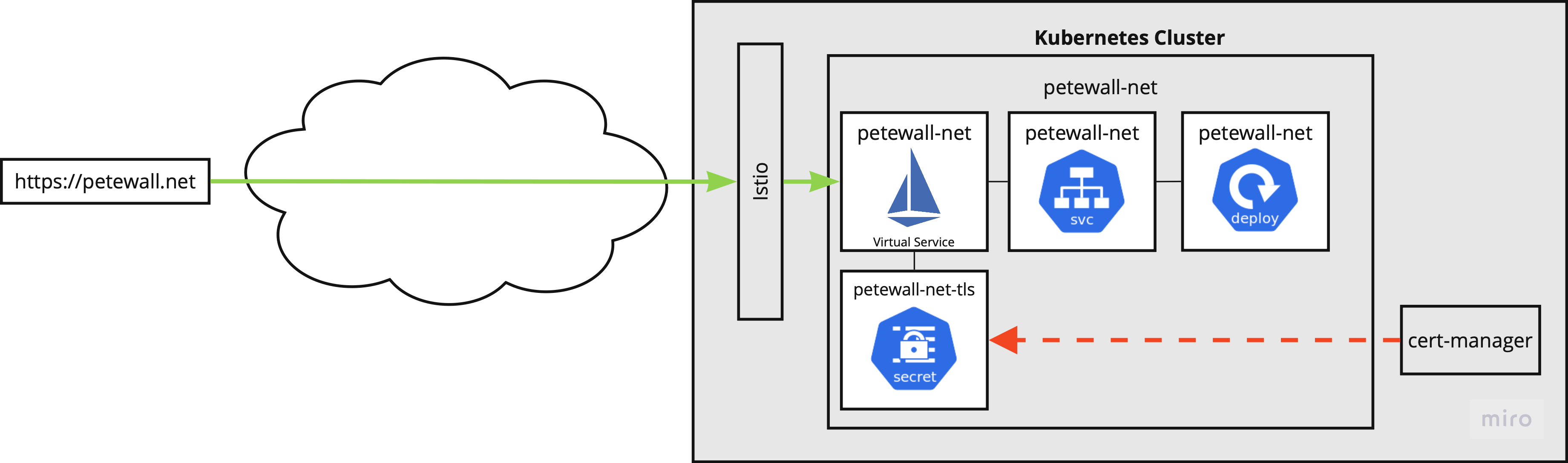
Compare this diagram to the one from the original post; so much simpler!
Why Hugo
I wanted a few things from the replacement:
- Content as files in git. No database, no admin UI, no “export to JSON” dance when something goes wrong. I’m an engineer, so for most of my “content”, the persistance layer is a git repository. Why not do the same thing here?
- A static output. I didn’t need server-side rendering, comments, or accounts. So, there’s an argument for simplification.
- A theme I didn’t have to design. I am not a designer, and I was not going to become one for this.
- Fast local previews.
make serveand I’m looking at the rendered post in a browser within a second.
Hugo checked all four boxes. The PaperMod theme checked the third one without me touching a stylesheet.
Deploying a static site
This is the part that felt the best. The deployment shrunk from “a Helm chart’s worth of YAML, a database, and a PVC” to a Dockerfile that’s four lines long:
FROM nginx:1.29-alpine

COPY nginx.conf /etc/nginx/conf.d/default.conf
COPY public /usr/share/nginx/html
That’s the whole thing. public/ is whatever hugo produces. The image is built and pushed to ghcr.io by a GitHub Actions workflow on every merge to main, and my cluster pulls the new tag. No more Ghost upgrade nights. No more Node.js CVE alerts to triage at 11pm. Nginx serves static files; that’s what nginx is for.
A few quality-of-life additions I made on top of the bare nginx image:
- Security headers. HSTS,
X-Content-Type-Options,Referrer-Policy, and aContent-Security-Policythat’s strict but allows the bits I actually use. - A
/healthzendpoint so Kubernetes liveness probes don’t have to fetch the homepage. - Host-portable
baseURLrewriting. Hugo bakeshttps://petewall.net/into the generated HTML, but I want the same image to work for PR previews onpetewall.github.iowithout rebuilding. An nginxsub_filterrewrites that prefix at request time using$http_hostand the forwarded scheme.
PR previews for free
The other thing I got out of moving to a static site: cheap, throwaway preview environments. Every pull request triggers a workflow that builds the site and publishes it to https://petewall.github.io/petewall.net/pr-<N>/. Closing the PR cleans it up. With Ghost, “previewing a draft” meant logging into the admin UI on production. Now I can open a PR with a half-written post and read it on a real URL before I merge.
Observability
I’ve been using Grafana Faro inside the old page for a while, and I wanted to keep that going. It’s given really nice insight into the health and performance of the website: page loads, web vitals, and any client-side errors get shipped to a Faro collector. The site is small, but it’s nice to know whether anyone’s actually hitting it and whether their browser is happy when they do.
Final thoughts
The general lesson, again, is the one I keep relearning in the home lab: match the complexity of the tool to the complexity of the job. Ghost is a great CMS, but I did not need a CMS. I needed a way to render markdown into HTML and serve it. Hugo plus a static nginx image is exactly that, and the difference in operational overhead is enormous.
The site you’re reading this on is now a single container, built from a directory of markdown files, deployed by a workflow that runs in under a minute. The ghosts are banished.
Image by Andrew Martin from Pixabay